To me, one of the most fascinating studies undertaken by the Weddell seal project is that which uncovered cohort effects in the Weddell seals of Erebus Bay in Antarctica's Ross Sea. The published scientific paper on this topic is “Environmental variation and cohort effects in an Antarctic predator” (Garrott et al. 2012).
 A very young Weddell seal pup and her mom.
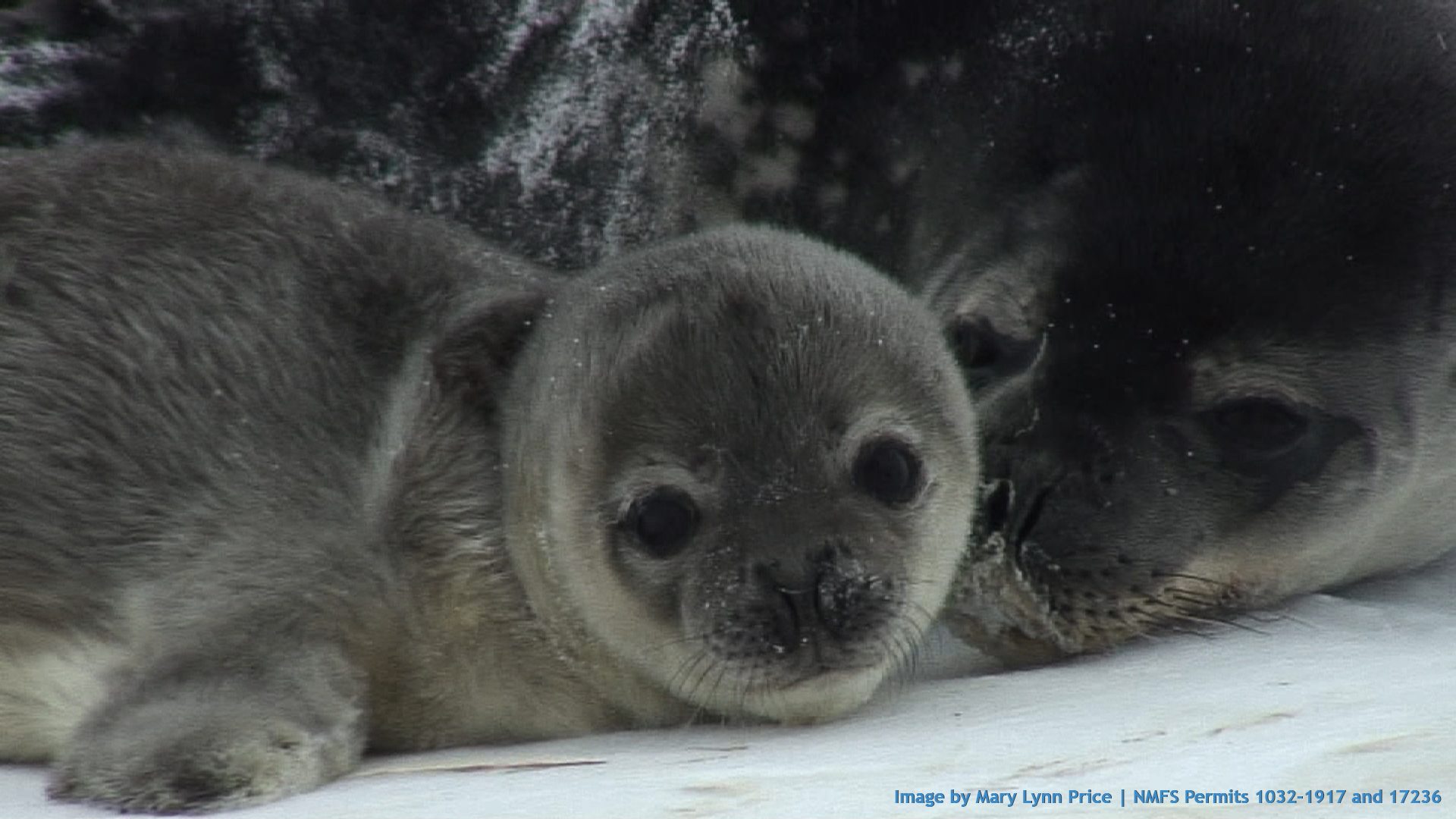
Cohort, here, refers to all of the Weddell pups born in the Erebus Bay study area in one pupping season, which occurs starting in mid-October and continues until late November each year. What makes this discovery especially interesting is that the scientists were able to take 30 year’s worth of data from 4178 tagged female Weddell pups born into 20 different annual cohorts, and 30 years of mark-resight observation data to discover that there are large differences in the proportion of each annual cohort that survives to return to the pupping colonies and produce a pup within 10 years of their birth. Because Weddell seal females have strong birth area fidelity (natal philopatry) and return to the area of their birth to give birth to their own pups, and it has been found that 93% of breeding females produce their first offspring by age 10 (Hadley et al. 2006), it is likely that Weddell females that have not recruited into the Erebus Bay breeding population within 10 years have died.
Two Weddell seals encounter each other under the sea ice in this video clip by Henry Kaiser, 2009.
The study data strongly supports an association between “cohort recruitment probability” and the regional extent of sea ice experienced by the mother during the winter the pup was in utero (Garrott et al. 2012). Cohort recruitment probability refers to the likelihood of female Weddell seal pups surviving to adulthood and returning to the pupping colonies as adults to give birth to pups of their own.
 Weddell seal moms and pups on the sea ice at Big Razorback Island colony.
There are probably many reasons why there are differences in the proportion of females of a cohort that return to reproduce, but project scientists suspect it all starts with whether the fertilized egg of a Weddell seal female implants in her uterus, which may be influenced by the level of nutrition the mom experiences during the austral summer. Another reason would be the level of nutrition the mom experiences in the austral winter as the pup is developing in utero, and the mom is continuing to gain mass.
 Two Weddell seals share a breathing crack in the sea ice.
Weddell seal females are “delayed implanters”. They usually mate underwater in early December at the end of the 30 to 45 day nursing period in the late austral spring or early summer. However, the fertilized egg does not implant in the mother’s uterus for a month or two after mating. Although we do not have physiological data, project scientists think that the more food resources available to the Weddell females in a particular austral summer season, the more likely the fertilized egg, or blastocyst, will implant in the mom’s uterus and the embryo will begin to develop and grow.
Continued in the next post…
– Mary Lynn Price
______________________
Thank you to Weddell project scientists and cohort effects paper authors Drs. Bob Garrott, Jay Rotella, and Don Siniff for their patient assistance reviewing and ensuring accuracy of this post.
______________________
Garrott, R. A. et al. 2012. Environmental variation and cohort effects in an Antarctic predator. – Oikos 121: 1027-1040.
Hadley, G. L. et al. 2006. Variation in probability of first reproduction of Weddell seals. – J. Anim. Ecol. 75: 1058-1070.
Leave a Reply